eng
 English
 русский
 Deutsch
 عربى
+86 189 6101 2359
+86 133 6521 5663
+86 138 5268 6835
Stainless steel 304 is one of the most common materials for bolts, screws, nuts, and washers. It balances corrosion resistance, formability, and cost. But when a joint carries sideways load, the question quickly becomes specific: what is the shear strength of stainless steel 304, and how should that number be used?
Shear strength is not a single fixed value. This guide explains typical values, the metallurgical and mechanical factors that change them, and practical ways to turn material data into a dependable joint. We will keep the discussion useful for engineers, buyers, and maintenance teams who specify 304 fasteners in real equipment.
Content
Shear strength describes a material's ability to resist sliding failure across a plane. A bolt in a lap joint, a pin in a clevis, or a screw carrying a transverse load may fail by shear before it fails in tension. The stress is calculated as force divided by the area carrying that force.
For 304 stainless steel, also known as 18/8 or A2, the shear modulus is about 77 GPa (11.2 × 10^6 psi). That figure describes stiffness, not failure. Shear strength is the stress at which the material begins to fail in shear, and it depends on condition, temperature, and the way the part was made.
Annealed 304 is the baseline. Cold working raises tensile and yield strength, and shear strength generally follows. The table below gives approximate room-temperature values for planning. They are not design allowables.
| Condition | Tensile strength, MPa (ksi) | Yield strength, MPa (ksi) | Estimated shear strength, MPa (ksi) |
|---|---|---|---|
| Annealed 304 | 515 (75) | 205 (30) | About 310 (45) |
| Cold-worked 304, quarter-hard | About 860 (125) | About 515 (75) | About 520 (75) |
| Cold-worked 304, full-hard | About 1,270 (185) | About 965 (140) | About 760 (110) |
These values illustrate a practical point: two parts both called "304" can behave quite differently. A soft annealed bracket and a cold-drawn fastener may share the same grade name but not the same shear capacity.
Annealed 304 has a tensile strength around 515 MPa and a yield strength around 205 MPa. Cold drawing, heading, or thread rolling increases dislocation density, raising strength and reducing ductility. Fasteners are often supplied in a controlled cold-worked condition. If a drawing says only "304," the temper and strength class are still open questions.
At room temperature, 304 is ductile and forgiving. At elevated temperature it softens gradually; above roughly 500 to 550°C, creep and oxidation become important. At cryogenic temperature, strength rises while ductility remains useful. Very fast loading can also change the apparent shear strength, so impact or seismic applications deserve joint-level testing.
A rolled plate, a cold-headed bolt, and a machined pin do not necessarily have the same shear properties. Grain flow, inclusions, surface finish, and thread geometry all affect where a crack starts. Threads are stress concentrators, so a shear plane through the threaded portion is usually less favorable than one through the unthreaded shank.
For a simple shear joint, the basic relationship is V = τ × A, where V is shear capacity, τ is the design shear stress, and A is the shear area. A single-shear lap joint has one shear plane; a double-shear connection has two. The calculated capacity must then be reduced by an appropriate safety factor and checked against bearing, tear-out, and edge distance.
The shear plane location matters. If the unthreaded shank crosses the joint interface, use the shank area. If threads cross the interface, use the threaded stress area or the thread shear area, following the relevant code. Preload also matters: a properly tightened joint carries much of the load by friction, while a loose joint relies more on bolt shear and hole bearing.
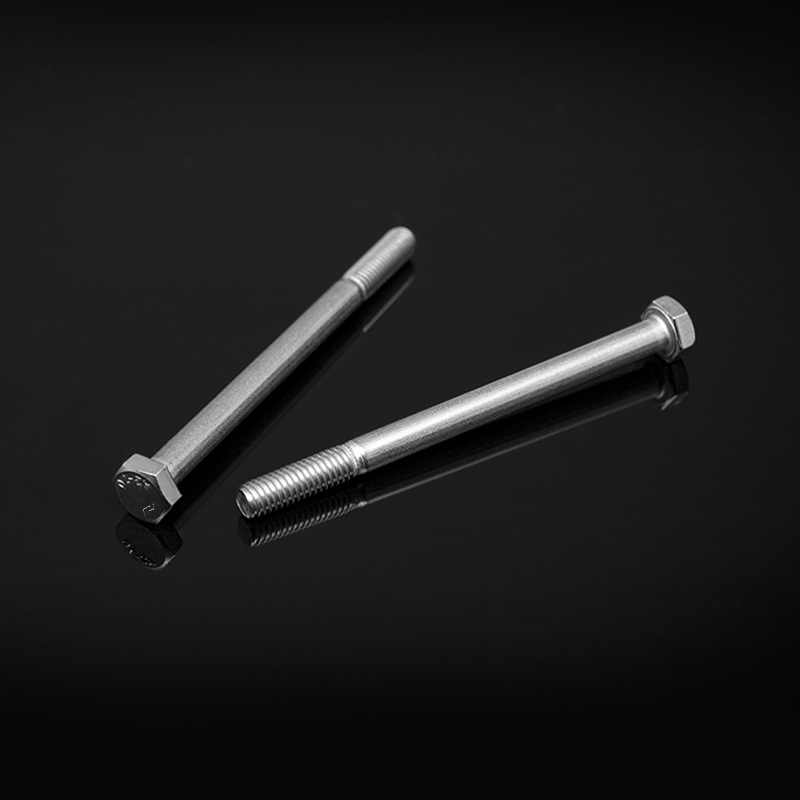
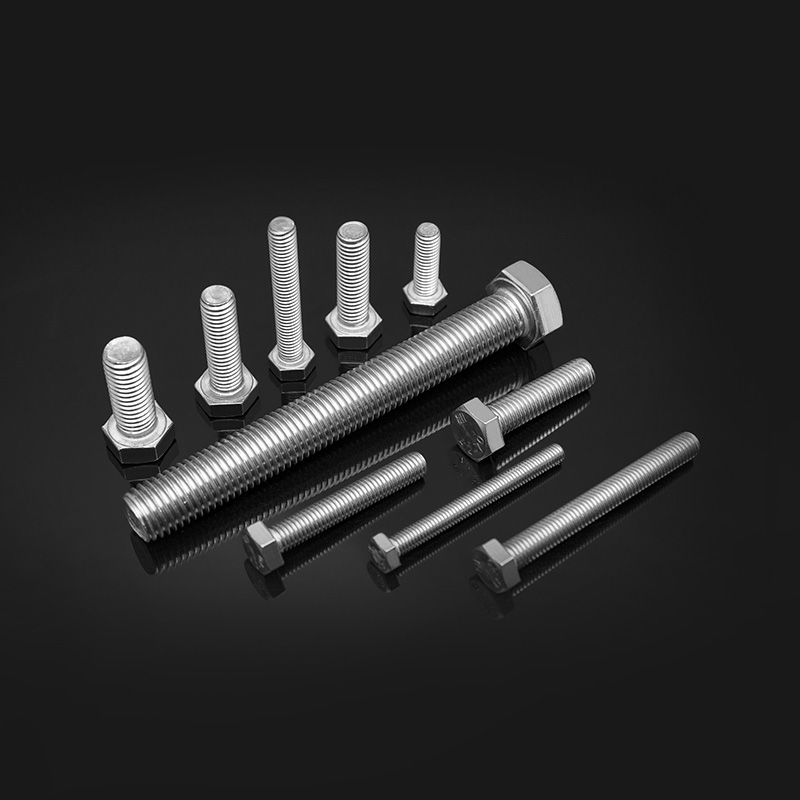 DIN 933 Fully Threaded Stainless Steel Hex BoltsFully threaded stainless steel hex bolts for heavy-duty connections; check diameter, length, material and load capacity where thread position affects joint design.View Product →
A fully threaded bolt such as DIN 933 places threads along the full length, which can be convenient but means the threads may sit in the shear plane. Partial-thread bolts keep the unthreaded shank at the joint interface when the grip length is chosen correctly. The right choice depends on the joint, not on habit.
Good joint design keeps the fastener well below its shear strength in normal service. Use sufficient clamp load, control hole clearance, and avoid excessive thread in the shear plane. Washers can spread bearing pressure and protect softer mating surfaces, while nuts should be matched to the bolt material and lubrication should be considered to reduce galling.
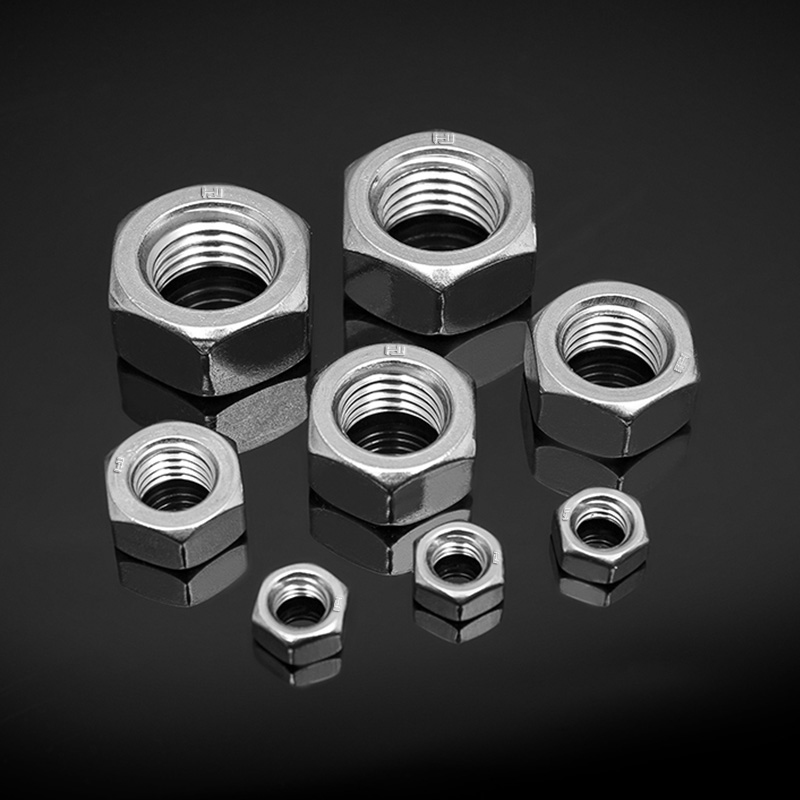 DIN 934 and GB 6170 Stainless Steel Hex NutsStainless steel hex nuts in 304 or 316; match thread diameter and material to bolts, with lubrication considered to reduce galling in stainless joints.View Product →
304 stainless fasteners can gall when stainless nut and bolt threads rub under high pressure. A suitable anti-seize lubricant or a different material pairing may help, but the lubricant must be compatible with the service environment. In our fastener production, we pay close attention to thread finish and dimensional control because these details influence both assembly and load transfer.
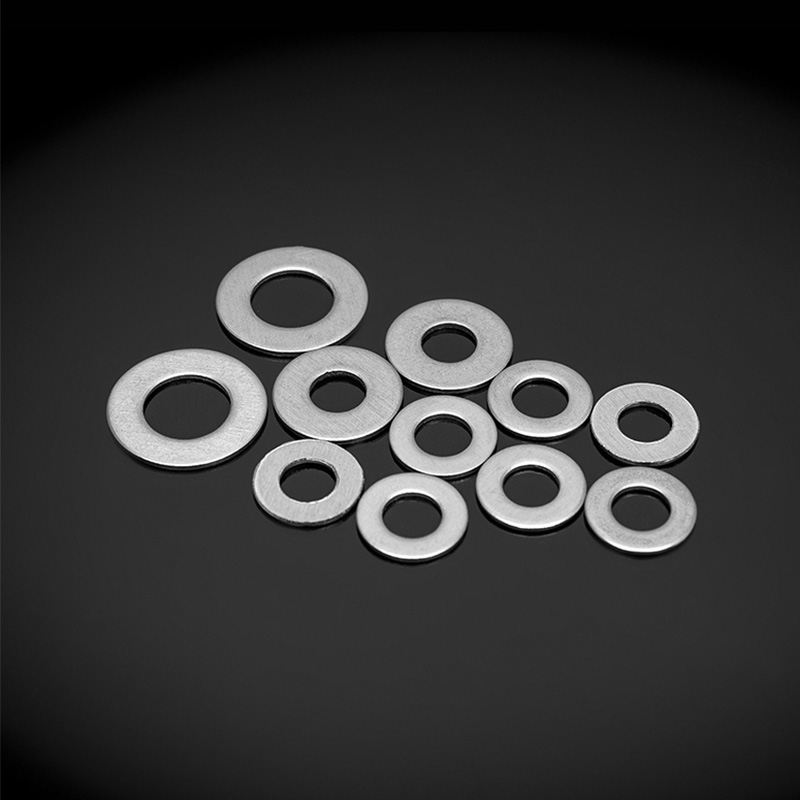 DIN 125 Stainless Steel Plain WashersStainless steel flat washers for basic mechanical connections; use them to spread bearing load and reduce wear around clearance holes under ordinary loads.View Product →
Flat washers are not a substitute for proper preload, but they improve load distribution and reduce the risk of local yielding around a clearance hole. In thin-sheet or slotted connections, a washer can make the difference between a stable joint and one that loosens in service.
304 retains useful strength at low temperature and moderate heat, but long exposure above about 500°C can cause creep and scaling. Corrosion usually does not change short-term shear strength directly; it reduces section thickness, creates pits, and starts cracks. In chloride-rich or marine environments, 316 stainless may be more appropriate because its molybdenum content improves pitting resistance. If you are comparing the two alloys, our discussion of 304 and 316 threaded rod covers the trade-offs in strength and corrosion behavior.
Because "304" alone does not define shear strength, specify the condition and verification method. A clear purchase description can prevent a costly mismatch between material certificate and real joint performance.
Our experience with stainless fasteners for transport, energy, and industrial machinery points to the same conclusion: material grade is only one part of the answer. Condition, thread geometry, installation, and environment determine how a 304 fastener performs in shear.
A well-specified 304 joint can be a reliable and economical solution. The key is to treat shear strength as an engineering input, not a single headline number, and to confirm the details that control real-world performance.
ThreadTolerance: 6gstandardDIN 13-15、DIN 13-12Rod diameter dd≤M20:A2-70、A4-70;M20<d≤M39:A2-50、A4-50;d≥M39:C3、C4;d<M39
See Details
Copyright © Jiangsu Huajie Stainless Steel Products Co., Ltd. All Rights Reserved.