eng
eng English
 русский
 Deutsch
 عربى
عربى
+86 189 6101 2359
+86 133 6521 5663
+86 138 5268 6835
Imagine tightening a set screw on a water pump shaft and feeling the pulley lock in place. Or adjusting a bicycle gear shifter cable with one small, headless fastener. A set screw is a fully threaded screw that works by pressing its tip against a second part, creating friction that stops relative movement between the two components. This article explains the mechanics behind that grip, how different point types change performance, and what to check before specifying stainless steel set screws for your assembly.
Content
A set screw has no head. It screws into a tapped hole in the first component, and its projecting tip bears against the surface of the second component. The threads in the tapped hole convert your tightening torque into a clamping force at the tip. That clamping force generates a normal load, which in turn produces friction between the tip and the mating surface. This friction resists both rotary slip and axial movement.
The holding capacity depends on the point geometry, the material hardness of both parts, the thread size, and the applied torque. For example, a stainless steel socket set screw in an M4 tapped hole often has a recommended tightening torque range of 1.8 to 2.6 N·m. Exceed that range and you risk deforming the tip or stripping the internal hex socket; stay below it and the screw may back out under vibration. The headless design also lets the fastener sit completely recessed, which is important when the outer surface of the assembly must remain flush.
Point type is the critical variable that changes how a set screw behaves. Choosing the right one is not a cosmetic decision; it influences grip strength, surface marking, and whether the screw can be reused after disassembly.
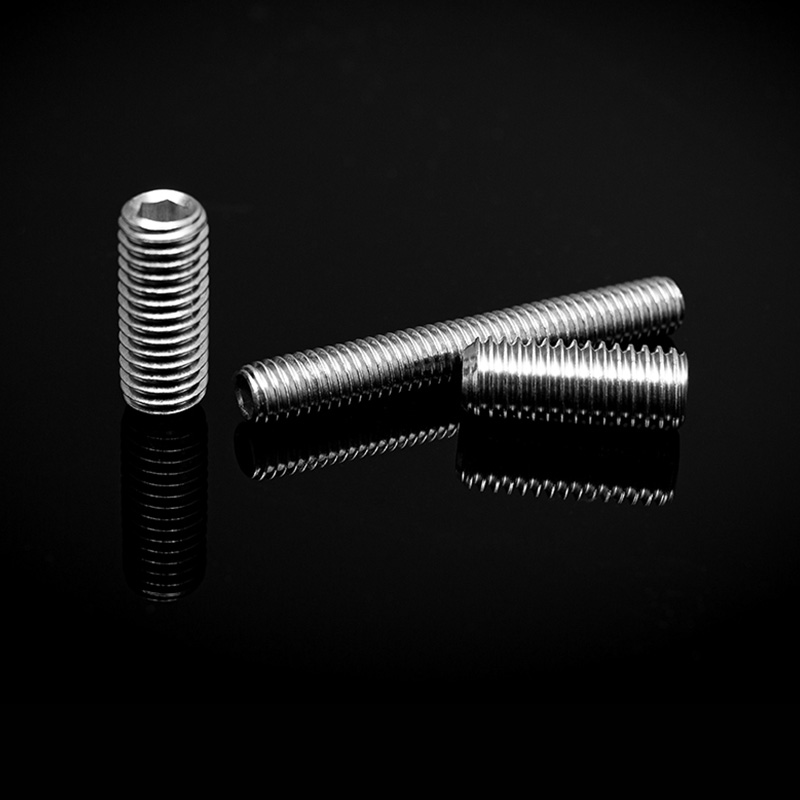
A flat point has a circular, flat contact face. It distributes pressure evenly across the mating surface, so it is less likely to leave a permanent dent or groove. This makes it a good choice for softer materials, for parts that need frequent adjustment, or when the shaft must remain undamaged. The trade-off is that a flat point transfers less torque than a sharper point design, so it is best suited for moderate loads and general-duty stainless steel assemblies.
 DIN 913 Stainless Steel Hex Socket Set Screws with Flat PointWith a flat contact face, these set screws distribute pressure evenly, reducing damage to mating surfaces. Ideal for soft materials, frequent adjustments, or when shaft integrity matters, though they handle moderate loads only.View Product →
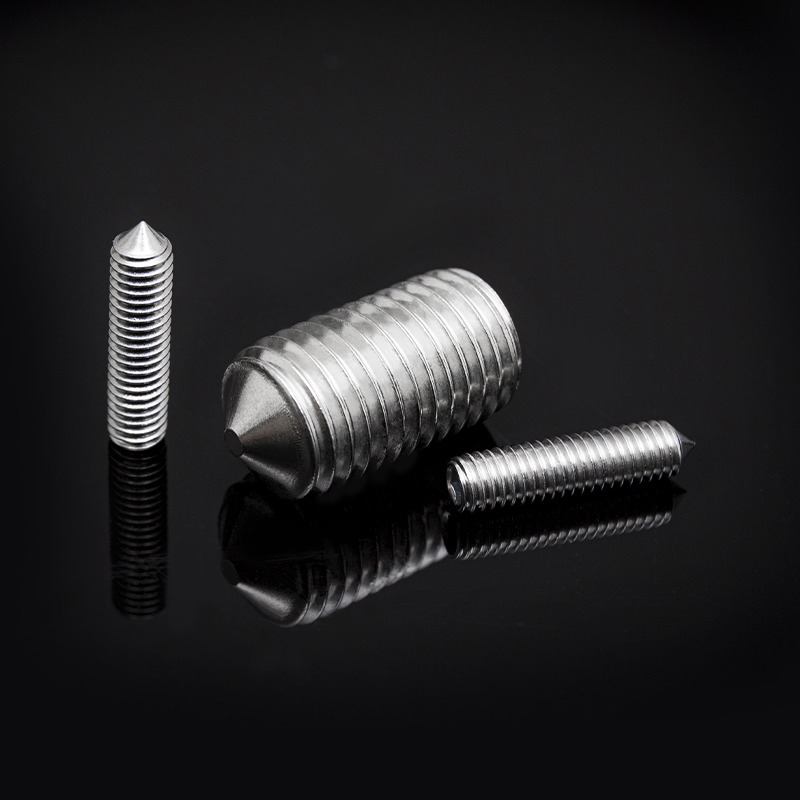
A cone point tapers to a sharp tip that bites into the mating surface. This gives a higher holding force and better resistance to vibration loosening. The downside is a permanent indentation in the shaft, so cone points are usually reserved for applications where the set screw is installed once and never repositioned. In hardened shaft materials, a cone point may not gain enough depth to lock; in softer ones, it can create a strong mechanical bite. It is a common standard for industrial shaft-to-hub connections.
 DIN 914 Stainless Steel Hex Socket Set Screws with Cone PointFeaturing a sharp cone tip, these set screws bite into the surface for high holding force and vibration resistance. Best for one-time installations where a permanent indentation is acceptable, common in shaft-to-hub connections.View Product →
A dog point has a protruding cylindrical tip that fits into a pre-drilled hole, slot, or groove. Instead of relying only on friction, it provides a positive mechanical stop. This makes it ideal for precise axial location, for parts that will be disassembled and reassembled repeatedly, or for mating surfaces too soft to accept a cone point. Because the tip engages a defined feature, the screw can be reused without losing positional accuracy.
Correct installation starts with a clean tapped hole and a matching hex key or drive tool. Align the set screw squarely with the shaft center, then tighten to the torque value specified for the thread size and material. This is especially important when both the screw and the mating part are stainless steel, because stainless steel can gall or seize during tightening. A light coat of anti-seize compound often helps.
Common mistakes include over-tightening, which leads to stripped sockets or permanent deformation of the shaft, and under-tightening, which lets the screw loosen under dynamic loads. Using the wrong point type for the application is another frequent issue. For instance, a flat point on a hardened shaft may not hold at all, while a cone point on a polished, repeated-use component may create unacceptable surface marks. If vibration is a concern, consider a thread-locking compound or a second set screw installed at a different angle to increase resistance to loosening.
Set screws are made from alloy steel and stainless steel. In corrosive environments, stainless steel grades 304 and 316L are preferred. Grade 304 offers good general corrosion resistance and is suitable for many industrial and outdoor applications. Grade 316L contains molybdenum, giving it improved resistance to chlorides, salt spray, and chemicals. For food processing, marine, and chemical plant equipment, 316L is usually the safer specification.
Standards such as DIN 913, DIN 914, and DIN 915 describe the point types and dimensions for flat, cone, and dog point set screws. Many manufacturers also produce them according to GB, ANSI, and ISO standards, which can simplify sourcing if you work with international suppliers. When selecting a material, consider the holding force needs, the shaft hardness, and the environmental exposure. For a quick refresher on the key advantages of stainless steel set screws, you can review how they outperform carbon steel versions in corrosive assemblies.
Before you purchase set screws for a production run, confirm the exact point type, thread pitch, drive socket size, and material grade. Coarse threads provide more holding capacity in softer materials; fine threads are preferable for hardened surfaces and precise adjustments. Also check whether the supplier can provide material test certificates and batch traceability.
Consistency matters in high-volume and safety-critical applications. A manufacturer with ISO 9001, ISO 14001, and ISO 18001 certifications and in-house engineering support offers better control over dimensions, hardness, and surface finish. If you are not certain which point type will handle your load conditions, ask your fastener supplier for a recommendation based on your shaft material, rotation speed, and disassembly frequency. Choosing the right stainless steel set screw from the start saves you from field failures and rework later.
Set screws are small, but the clamping force they create has a direct impact on the reliability of your assembly. Understand the mechanics of the tip contact, match the point type to your mating material, and follow the recommended torque. With the correct stainless steel grade and a careful installation, a set screw can hold firmly for years of service.
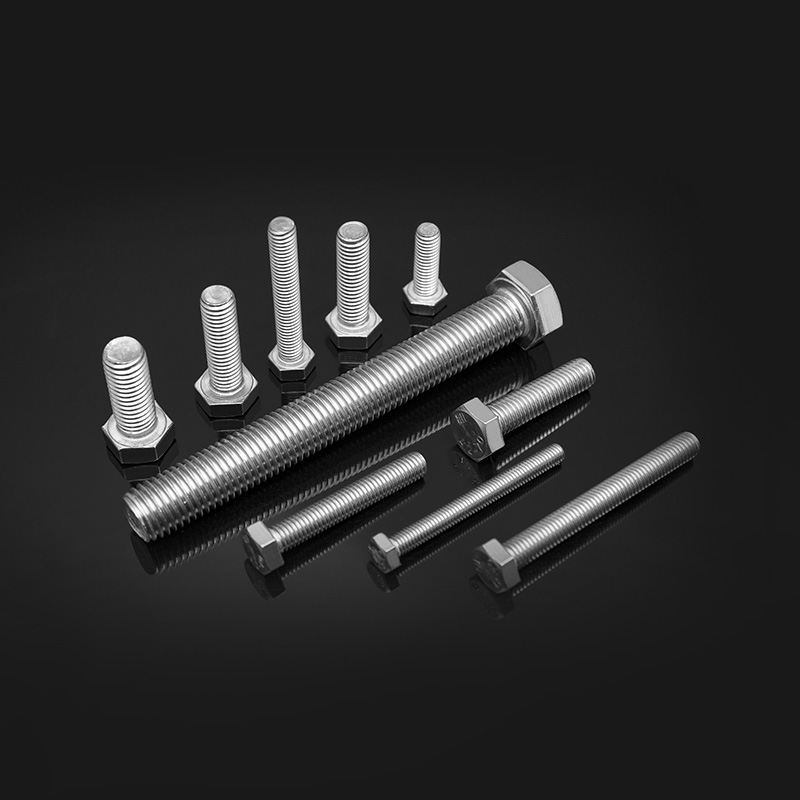
ThreadTolerance: 6gstandardDIN 13-15、DIN 13-12Rod diameter dd≤M20:A2-70、A4-70;M20<d≤M39:A2-50、A4-50;d≥M39:C3、C4;d<M39
See Details
Copyright © Jiangsu Huajie Stainless Steel Products Co., Ltd. All Rights Reserved.