eng
eng English
 русский
 Deutsch
 عربى
عربى
+86 189 6101 2359
+86 133 6521 5663
+86 138 5268 6835
Order a batch of "set screws" for a shaft collar job and what arrives depends on which side of the Atlantic your supplier sits on: headless socket-driven screws in the United States, and in parts of the UK trade, fully threaded hex head bolts. Neither is wrong. The two names overlap so heavily that the mismatch is easy to miss until the parts are on the bench. Here is the short answer: in most technical contexts a grub screw and a set screw are the same part — a headless, fully threaded screw that presses against a shaft or mating component to lock it in place — while British trade usage also applies "set screw" to fully threaded hex head bolts. The choices that actually determine performance are the point style, the drive, and the material grade, not the label on the box.
Content
In American and general international usage, a set screw secures one component against another — a hub, collar, gear, or pulley against a shaft, for example — without a nut. It is threaded along its entire length and normally has no head at all, so the complete screw sits inside a tapped hole, flush with or slightly below the surrounding surface. A grub screw is exactly that same headless, fully threaded screw. The term is standard in the United Kingdom, much of the Commonwealth, and a large share of European technical literature, and reference works treat the names as synonyms: a set screw threaded along its full length that sits entirely inside the hole is called a grub screw.
The complication is a second, purely British meaning. In UK trade language, a "set screw" can also be a fully threaded hex head bolt of the type described by DIN 933 and its British Standard equivalents, so a UK drawing calling for set screws may mean wrench-driven hex bolts rather than Allen-key-driven headless screws. American usage almost never does this. A few suppliers add a third distinction based on threading — grub screws fully threaded, set screws sometimes partial — but standard stainless headless screws made to DIN 913, 914, 915, and 916 are produced fully threaded, so this rarely changes a purchasing decision in practice.
The table below condenses the terminology so you can quickly check what a drawing, catalogue, or supplier means before placing an order.
| Attribute | Grub screw | Set screw (US / international) | Set screw (UK trade usage) |
|---|---|---|---|
| Head | None | None in most designs | Hex head |
| Drive | Hexagon socket, slotted, or square | Hexagon socket most common | Wrench on the hex head |
| Thread | Fully threaded | Fully threaded | Fully threaded |
| Position in assembly | Sits entirely inside the tapped hole | Sits entirely inside the tapped hole | Passes through parts or into a tapped hole |
| Typical job | Locks a collar, gear, or pulley onto a shaft | Same as grub screw | General bolting and joining |
Once the naming question is settled, selection comes down to the tip. Headless set screws are classified by the shape of the point that bears against the shaft, and each shape trades grip against surface damage in a different way.
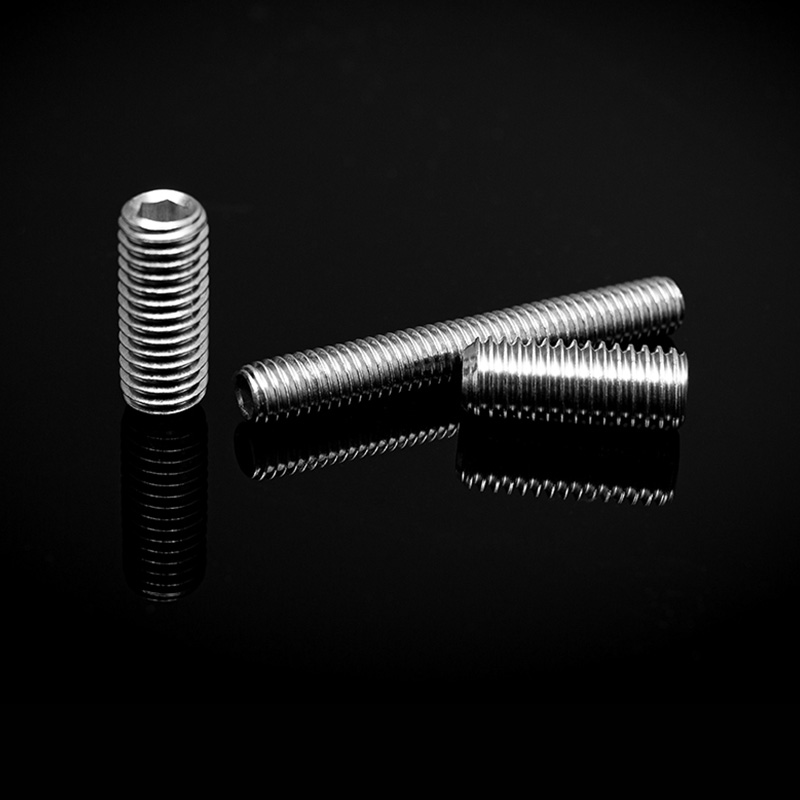
A flat point presents a flat face perpendicular to the thread axis, spreading the clamping load over a small circle without digging in. It deforms the mating surface the least, which makes it the preferred choice for hardened shafts, thin-walled hubs, and any assembly that gets repositioned regularly.
DIN 913 stainless steel hexagon socket set screws with flat point DIN 913 Stainless Steel Hexagon Socket Set Screws With Flat PointWith a flat face perpendicular to the thread axis, these set screws spread clamping load without digging into the mating surface, making them well suited to hardened shafts, thin-walled hubs, and frequently repositioned assemblies.View Product →
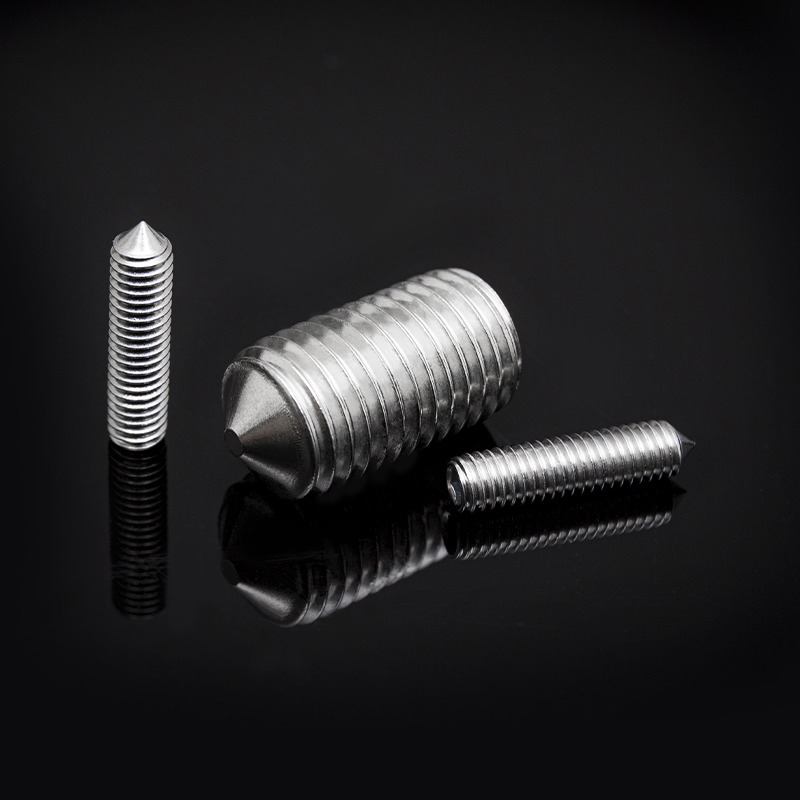
A cone point narrows to a sharp angle, typically 45 degrees, and bites into the shaft to deliver the highest resistance to torque and axial slip. That aggressive grip suits permanent or semi-permanent settings on softer steel where a small indentation in the shaft is acceptable.
DIN 914 stainless steel hexagon socket set screws with cone point DIN 914 Stainless Steel Hexagon Socket Set Screws With Cone PointFeaturing a cone point narrowed to roughly 45 degrees, these set screws bite into the shaft for maximum resistance to torque and axial slip, ideal for permanent or semi-permanent fastening on softer steel where small indentation is acceptable.View Product →
A dog point carries a short cylindrical pilot below the thread diameter. Seated into a matching hole or groove, it locates the part positively while still permitting rotation around the screw — the standard arrangement for clamping levers, adjustable handles, and pivoting members. A cup point, a shallow and usually knurled recess, is the most widely used general-purpose style because it balances a firm bite with limited marring, while an oval point rounds off for contact on angled or curved surfaces.
For industrial buying, these points map directly onto the DIN 913 (flat), DIN 914 (cone), DIN 915 (dog), and DIN 916 (cup) standards, with ISO 4026 through 4029 as their international counterparts. Stating the standard and the point style together on a purchase order removes nearly all ambiguity.
The hexagon socket drive dominates because it transmits more torque than a slotted drive of the same diameter before the recess deforms. Slotted grub screws survive in light-duty positions and older machinery; square sockets appear mainly in legacy equipment. Because there is no head to grip, a rounded-out socket on a headless screw is genuinely difficult to remove — drilling the screw out, using extraction tools, or welding a temporary nut onto the exposed end are the usual remedies. Specifying correctly sized, hardened keys and checking torque at assembly costs far less than recovering a stripped screw from a running machine.
Holding power also depends on engagement and vibration. Threads should engage deeply enough for the screw to develop full clamping force against the shaft, and on vibrating equipment engineers routinely add a thread-locking compound, a factory-applied nylon patch, or a second set screw at 90 degrees to the first. A surprising number of field failures trace back to a single undersized set screw holding a rotating element that gradually worked loose.
The headless format appears wherever a rotating or adjustable component must be fixed against a shaft without anything protruding: shaft collars and bearing lock rings, pulleys, sprockets, gears and timing-belt hubs, machine tool handles, control knobs, valve stems, actuators, and robotic joints. Rail, nuclear, petrochemical, and aerospace assemblies rely on them in confined spaces where a projecting head would foul guards or moving parts.
Point choice follows the duty. Dog point screws seat in a groove where a lever must pivot or a knob must turn without losing its registered position; cone points index components permanently on softer shafts; flat and cup points handle routine collar and hub fixing.
DIN 915 stainless steel hexagon socket set screws with dog pointMaterial decides service life. A2 stainless steel (304) covers most industrial indoor and outdoor service; A4 / 316L is the default for marine, coastal, chemical, and chloride-heavy environments where pitting corrosion would eventually seize or weaken an A2 screw; 201 grades serve cost-sensitive indoor assemblies. Because headless screws press directly against the shaft and thread into the hub, galling between stainless threads is a real risk — a controlled torque value or a suitable anti-seize compound keeps removal possible years later.
A short list keeps the terminology trap and the technical details from slipping through:
Treat grub screw and set screw as the same headless fastener until a drawing, a regional habit, or a supplier catalogue says otherwise — then verify the point style, drive, and material as if the name did not exist, because those three choices decide whether the collar stays put under load. For volume projects, it pays to source directly from a stainless steel fastener manufacturer that produces DIN and ISO set screws in 304 and 316L with in-house testing and multi-standard capability, since consistent grade and tolerance across batches matter more on headless screws than on almost any other fastener type. For a closer look at the headless type on its own terms, the guide to the key advantages of stainless steel set screws walks through the selection criteria in more detail.
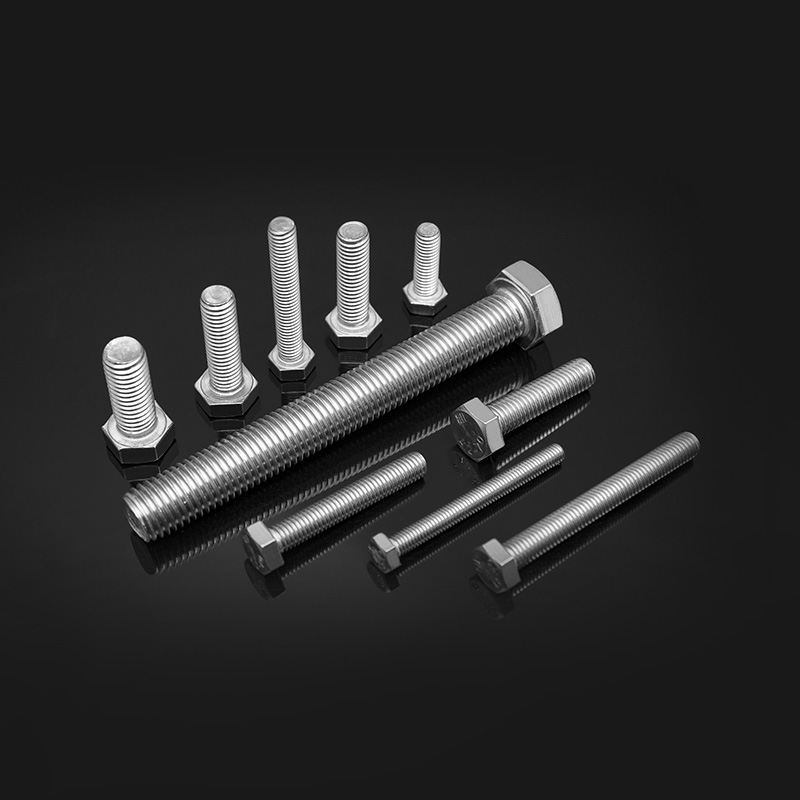
ThreadTolerance: 6gstandardDIN 13-15、DIN 13-12Rod diameter dd≤M20:A2-70、A4-70;M20<d≤M39:A2-50、A4-50;d≥M39:C3、C4;d<M39
See Details
Copyright © Jiangsu Huajie Stainless Steel Products Co., Ltd. All Rights Reserved.