eng
eng English
 русский
 Deutsch
 عربى
عربى
+86 189 6101 2359
+86 133 6521 5663
+86 138 5268 6835
Content
A fastened joint is only as reliable as every component within it -- and the washer, though the smallest and least expensive part in most assemblies, carries a disproportionate influence on how well the joint performs over time. Stainless steel washers distribute the clamping load of a bolt or nut across a larger bearing area, protect substrate surfaces from damage during tightening, prevent fastener loosening under vibration, compensate for surface irregularities, and in corrosive environments, provide the chemical resistance that allows the entire fastener assembly to survive where carbon steel would fail within months.
The two most widely specified stainless steel washer types -- the stainless steel flat washer and the stainless steel spring washer -- perform fundamentally different functions within a fastened joint, and confusing the two or selecting the wrong type for the application is one of the most common causes of joint failure in corrosive or vibration-prone environments. This guide covers both types in complete technical depth, including stainless grades, relevant standards, sizing rules, installation practice, and application-specific selection criteria.
Before addressing washer type, the stainless steel grade must be matched to the operating environment. The grade governs corrosion resistance, mechanical strength, and suitability for specific media -- and specifying the wrong grade in a corrosive environment produces premature failure regardless of how well the washer type itself is matched to the joint design.
Grade 304 -- referred to as A2 stainless steel in the ISO classification system and commonly marketed as 18-8 stainless (reflecting its approximate composition of 18 percent chromium and 8 percent nickel) -- is the most widely used stainless steel grade for washers in general industrial and commercial applications. 304 (18-8) is suitable for general indoor and light outdoor use, providing general corrosion resistance and a clean appearance. It resists oxidation and atmospheric corrosion effectively, tolerates a wide range of temperatures, and is non-magnetic in its annealed condition. Grade 304 stainless steel washers are the standard specification for food processing equipment, general construction, indoor plumbing, architectural metalwork, and any application where moderate corrosion resistance is required and chloride exposure is absent or minimal.
The limitation of grade 304 is its susceptibility to pitting corrosion in the presence of chloride ions -- even at relatively low concentrations. Salt spray, coastal air, seawater immersion, or contact with de-icing salts will cause grade 304 washers to pit and discolour within months, undermining joint integrity and creating unsightly staining on the fastened assembly.
Grade 316 -- classified as A4 stainless in the ISO system -- is the marine-grade stainless steel. Its composition adds 2 to 3 percent molybdenum to the chromium-nickel base of grade 304, and this addition fundamentally transforms the alloy's resistance to chloride-induced pitting and crevice corrosion. The most common grade of stainless steel flat washer is A4, which is synonymous with alloy 316 or marine grade stainless steel. Grade A4 is known for its increased resistance to chloride corrosion in comparison to alloy 304. 316 stainless steel has a higher corrosion resistance than 18-8 or 304 stainless steel.
Grade 316 stainless steel washers are the mandatory specification for marine and offshore applications, coastal construction, chemical processing involving halide-containing media, food production environments cleaned with chlorinated agents, and any installation where prolonged exposure to salt water, salt air, or chlorinated water is expected. Use 316 in marine, salt, or aggressive environments and pair with 316 fasteners when possible. The cost premium of grade 316 over grade 304 is typically 20 to 40 percent -- a modest investment relative to the maintenance and replacement costs generated by premature corrosion failure in a chloride environment.
Grade 316L is the low-carbon variant of 316, with carbon content limited to 0.03 percent maximum. The reduced carbon content prevents chromium carbide precipitation at grain boundaries during welding -- a phenomenon called sensitisation that can cause intergranular corrosion in the weld heat-affected zone of standard 316 components. For washers used in welded assemblies or at elevated service temperatures above 450 degrees Celsius, specifying 316L rather than standard 316 eliminates this risk. For fastener applications at ambient temperature with no welding, the practical performance difference between 316 and 316L is negligible and specification of either is acceptable. Beyond the 304 and 316 families, duplex stainless steels (such as grade 2205) offer superior strength and pitting resistance for highly aggressive chemical environments, and grade 310 is specified for high-temperature applications above 800 degrees Celsius where austenitic stability must be maintained.
| Grade | ISO Designation | Key Alloying Addition | Chloride Resistance | Typical Application |
|---|---|---|---|---|
| 304 (18-8) | A2 | 18% Cr, 8% Ni | Moderate -- not for sustained salt exposure | General industrial, food equipment, indoor construction |
| 316 | A4 | 18% Cr, 10% Ni, 2-3% Mo | High -- suitable for marine and chloride environments | Marine, offshore, chemical, coastal construction |
| 316L | A4L | As 316 plus carbon max 0.03% | High -- same as 316 plus weld zone protection | Welded assemblies, elevated temperature service |
| 2205 Duplex | -- | 22% Cr, 5% Ni, 3% Mo, N | Very High -- superior pitting resistance | Aggressive chemical, subsea, high-strength requirements |
A stainless steel flat washer -- also called a plain washer -- is a thin, flat, circular disc with a central hole, manufactured to precise dimensional tolerances. Its geometry is simple, but each dimension is purposeful. The inner diameter is sized to slide over the bolt or screw shank with a controlled clearance -- tight enough to locate the washer concentrically but loose enough for easy assembly. The outer diameter determines how much bearing area the washer creates under the bolt head or nut. The thickness governs stiffness, load capacity, and whether the washer will deform plastically under the specified fastener preload.
Stainless steel flat washers are used under bolt heads or nuts to increase the bearing surface area, or to offer protection so that the nut or bolt can be rotated without distortion of the bearing surface. Flat washers are also used to give tightness to a joint, to prevent leakage, and especially to distribute pressure under the head of a bolt or nut. Expanding on these core functions:
Stainless steel flat washers are produced in several dimensional series, and selecting the correct series for the application ensures proper fit, adequate bearing area, and compatibility with the fastener standard being used:
ISO 7089 and related standards define two hardness classes for stainless steel flat washers -- 200 HV and 300 HV -- and these classifications govern which fastener property classes the washer is suitable to be used with. Washers of hardness class 200 HV are suitable for hexagon bolts and screws of product grades A and B in property classes up to and including 8.8 and hexagon bolts, screws and nuts of stainless steel of similar chemical composition. Washers of hardness class 300 HV are suitable for hexagon bolts and screws in property classes up to and including 10.9. In practice, the majority of stainless steel flat washer procurement for corrosion-resistant applications uses the 200 HV class, as stainless steel fasteners typically operate at property class equivalents below 8.8. For high-strength structural fasteners in property class 10.9, 300 HV hardness class stainless washers must be specified to prevent the washer from yielding under the fastener's full preload.
Match the nominal washer size to your fastener size. Confirm the inner diameter slides over the shank without binding. Select the outside diameter and thickness for the load you need to spread. Three specific checks should be made before confirming a flat washer specification:
A stainless steel spring washer is a non-flat, load-bearing washer that uses an elastic deformation geometry to maintain tension in a fastened joint under conditions where a plain flat washer would allow the joint to loosen. Where the stainless steel flat washer is a passive load-distribution device, the spring washer is an active preload-maintenance device -- it stores mechanical energy during tightening and releases that energy continuously to compensate for relaxation, vibration, and thermal cycling that would otherwise allow the fastener to back off.
Spring washers are a load-bearing device that provides a preload between two surfaces. Spring washers possess a spring rate, which is a characteristic that describes the deflection range and load capacity of the washer. Deflection and load ratings can be manipulated by stacking spring washers in series or parallel configurations. This stackability is a significant design advantage: stacking spring washers in parallel (same orientation) increases load capacity at the same deflection; stacking in series (opposing orientation) increases total deflection range while reducing load. Both configurations allow designers to tune the spring system to specific preload and compliance requirements without changing the washer size.
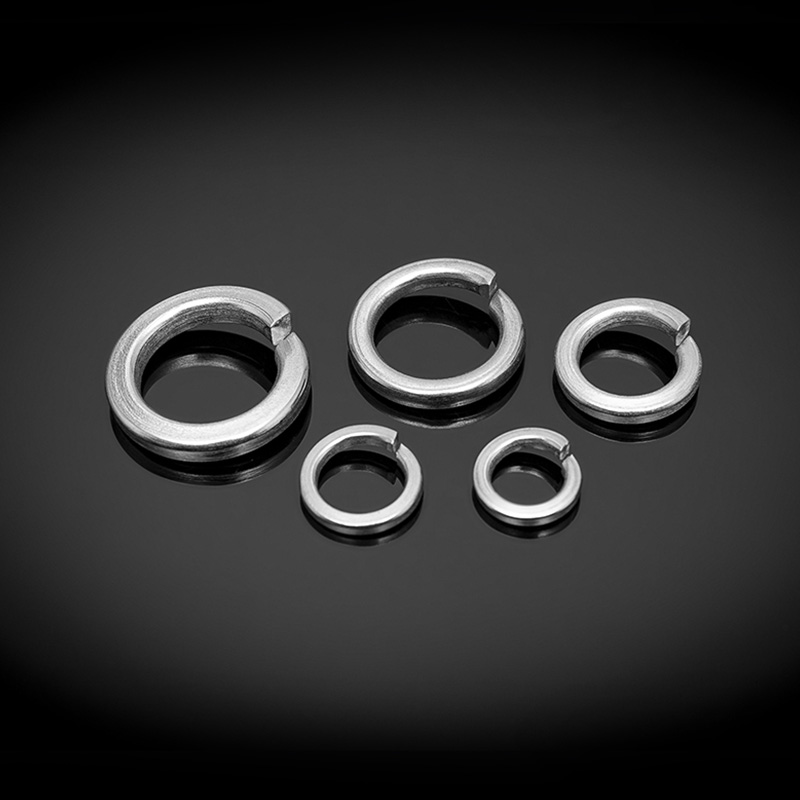
The split lock washer -- also called the helical spring washer or DIN 127 washer -- is the most commonly used spring washer type in general industrial fastening. It is manufactured from a single ring of stainless steel that has been split at one point and twisted so that the two ends are offset by approximately one washer thickness, creating a helix. When a nut is tightened onto the split lock washer, the two protruding ends bite into the nut face and the joint surface simultaneously, while the helical spring body stores elastic strain energy that maintains clamp force as the joint settles.
The split lock washer is a simple, low-cost, and effective anti-loosening device for applications subject to moderate vibration and where the joint surfaces are metallic and can accept the small indentations made by the washer ends. It is not appropriate for soft substrate materials (the biting action would embed deeply rather than biting, losing its locking effect) or for joints requiring very precise preload control (the spring rate varies with surface hardness and tightening speed). Spring lock washers from the inch series are available in ordinary, heavy, extra-duty, and high-collar varieties and are constructed from stainless steel, 65Mn or spring steel.
The Belleville washer -- named after its French inventor Julien Belleville and standardised in DIN 2093 -- is a conical disc spring with a precise, calculable spring rate. Unlike the split lock washer, which provides an empirical locking action, the Belleville washer is a precision spring element with defined load-deflection characteristics. Belleville washers are conical shaped and they act like springs to absorb tension. When compressed by bolt tightening, the cone deflects toward flat, storing elastic energy proportional to the deflection. As the joint relaxes through thermal cycling, vibration-induced settling, or creep of the joint materials, the Belleville washer extends, maintaining the preload within a defined range.
Belleville washers are specified in three load series -- A (light), B (medium), and C (heavy) -- with the series determining the cone height-to-thickness ratio and therefore the load capacity and deflection range. A single Belleville washer can generate clamping forces from a few newtons to tens of kilonewtons depending on size and series -- a range far exceeding the capability of any split lock washer. They are the correct choice for joints requiring controlled, sustained preload in applications including pressure vessel flanges, electrical contacts, pipe couplings, and precision bearing preloading.
Wave spring washers are curved in two directions and are typically employed as cushions or spacers. They can support a moderate amount of weight and guard against excessive wear on the surface. The wave washer has a sinusoidal wave form around its circumference -- typically three to six waves in the ring. When compressed, the waves flatten, providing a compliant spring action that is gentler than the sharp loading of a Belleville washer. Wave washers are used as light preload elements in bearing housings, as cushions between components that must remain in controlled contact without rigid metal-to-metal stacking, as take-up elements in assemblies with dimensional tolerances requiring compensation, and as vibration absorbers in rotating machinery where the wave geometry provides damping through controlled elastic deflection. Their load capacity is lower than Belleville washers of equivalent diameter, but their multi-contact geometry distributes load more evenly around the circumference.
The crescent spring washer, also called a curved spring washer, has a somewhat curved appearance that gives it a lighter pressure while maintaining flexibility. It is essentially a single-wave variant of the wave washer -- a flat disc that has been dished into a shallow dome. The curved washer provides low spring force with high deflection range, making it suitable for light-duty preload maintenance in consumer electronics, instrumentation, and small precision assemblies where a split lock washer would be too aggressive and a Belleville washer too stiff. In stainless steel, curved spring washers are used extensively in marine instrumentation, medical devices, and food processing equipment where the light spring action is combined with the corrosion resistance of the stainless material.
| Spring Washer Type | Standard | Load Capacity | Locking Mechanism | Best Application |
|---|---|---|---|---|
| Split Lock (Helical) | DIN 127 / ASME B18.21.1 | Low to Medium | Mechanical bite plus spring action | General industrial vibration resistance on metal joints |
| Belleville (Conical) | DIN 2093 | Medium to Very High | Precision spring preload maintenance | Flanges, bearing preload, pressure vessels, thermal cycling joints |
| Wave | DIN 137 / ASME B18.21.1 | Low to Medium | Multi-point spring compliance | Bearing housings, cushion spacers, vibration absorbers |
| Curved (Crescent) | DIN 137 variant | Low | Light preload, high deflection range | Instrumentation, electronics, medical devices, small assemblies |
Selecting the correct stainless steel washer combination -- grade, flat or spring type, and series -- for a given industrial application requires matching material and geometry to the three dominant service conditions: corrosion environment, loading type, and vibration exposure. The following application breakdowns illustrate how these criteria translate into specific washer specifications across major industries:
Marine environments combine continuous salt water or salt air exposure with vibration from engines, wave loading, and tidal currents. Grade 316 stainless steel is mandatory for all washers in direct marine exposure -- grade 304 will pit and stain within a single season in tidal or offshore conditions. Deck fittings, through-hull fasteners, and rigging hardware require 316 flat washers under all fastener heads and nuts. Where vibration from propulsion systems, generator sets, or wave action is significant, 316 split lock washers or wave washers are added to the assembly. For bolted flange connections in seawater pipework systems, 316 Belleville washers maintain gasket seating stress through the thermal cycling of the system and the creep relaxation of the gasket material.
Food and pharmaceutical processing environments require washers that resist corrosion from both the processed media and the aggressive cleaning agents -- typically chlorinated detergents and caustic solutions -- used in clean-in-place (CIP) and sterilise-in-place (SIP) protocols. 18-8 stainless steel fasteners are commonly used in applications that require general atmospheric corrosion resistance, such as chemical and food processing equipment. However, for environments with regular chlorinated cleaning cycles or direct food contact with acidic or salty products, grade 316 is the correct specification. All washers in hygienic installations must have smooth, burr-free surfaces with no crevices where bacteria can accumulate -- passivated grade 316 flat washers with a smooth stamped finish are the standard. Spring washers in food processing equipment are typically Belleville or wave type, as split lock washers with their open helical geometry can trap food residues and are difficult to clean to hygienic standards.
Chemical processing plants handle a wide spectrum of corrosive media at elevated temperatures and pressures. The correct stainless washer grade depends entirely on the specific chemical being handled -- there is no universal specification across the chemical industry. For dilute acids, alkalis, and oxidising solutions, grade 316 provides adequate resistance. For concentrated acids or strongly reducing environments, duplex 2205 or higher-alloy grades may be required. Bolted pipe flange connections -- the predominant application for washers in chemical plant -- rely on Belleville stainless steel spring washers to maintain gasket stress through thermal cycling from process start-up and shutdown, preventing leaks that would result from pure flat washer installations where the preload relaxes as the gasket creeps and the joint material expands and contracts.
Stainless steel washers in construction and architectural applications serve both structural and aesthetic functions. External cladding panels, glass structural fittings, balustrade systems, and roofing fasteners all use stainless washers that must maintain appearance and structural integrity over building lifetimes of 50 years or more. Grade 316 is specified for coastal buildings; grade 304 is acceptable for inland environments with low atmospheric pollution. Large outer diameter USS or DIN 125 series stainless flat washers are used to distribute load on thin-gauge steel sheeting and composite cladding panels where pull-through failure would otherwise occur at standard bolt head bearing area. In seismic zones, stainless steel spring washers in structural connections help absorb dynamic loads and prevent fastener loosening during seismic events.
Automotive applications for stainless steel washers concentrate in areas exposed to road salt, exhaust gases, and continuous vibration -- exhaust system connections, underbody fasteners, brake caliper mounts, and suspension components. SAE-series stainless flat washers are the dimensional standard for automotive fastener joints, and in applications where the washer goes through cyclic loading, as is the case for spring washers, yield strength and fatigue resistance are important design criteria. For high-vibration automotive joints such as engine mounts and exhaust manifold studs, stainless spring washers must be specified from materials with adequate yield strength to maintain spring action through millions of load cycles without taking a permanent set. Grade 304 is acceptable for inland vehicle applications; grade 316 is specified for vehicles operating in high-salt environments or coastal regions where road salt exposure is year-round.
The most common specification question in washer selection is whether to use a flat washer alone, a spring washer alone, or both together. The answer depends on which function -- load distribution or preload maintenance -- is the governing requirement of the joint, and whether the two functions must be combined.
Galvanic corrosion occurs when two dissimilar metals are in electrical contact in the presence of an electrolyte (water, humidity, or condensation). The less noble metal in the galvanic couple acts as the anode and corrodes preferentially. Stainless steel sits near the noble end of the galvanic series, which means that when it is coupled with a less noble metal, the other metal corrodes rather than the stainless. This is generally beneficial for the stainless washer but can cause accelerated corrosion of the adjacent material -- particularly aluminium, zinc, or carbon steel substrates.
Mixing stainless washers with galvanised bolts is possible, but consider galvanic corrosion outdoors. Matching materials across the joint is usually safer. The practical pairing rules for stainless steel washer installations are straightforward: use stainless steel washers with stainless steel bolts and nuts as a matched set. If stainless washers must be used with galvanised or carbon steel fasteners, apply a non-conductive sealant or install PTFE isolation tape at the metal-to-metal interface in corrosive outdoor environments to break the galvanic circuit. Never use stainless steel washers with aluminium fasteners in wet environments -- the stainless-aluminium galvanic couple with chloride electrolyte produces rapid aluminium corrosion that will seize and destroy the fastener within months.
The quality of stainless steel washers -- particularly for critical industrial, marine, and structural applications -- must be verified against defined manufacturing standards rather than assumed from appearance alone. The following quality criteria distinguish reliable industrial-grade stainless washers from commodity products that may fail dimensional or material specifications:
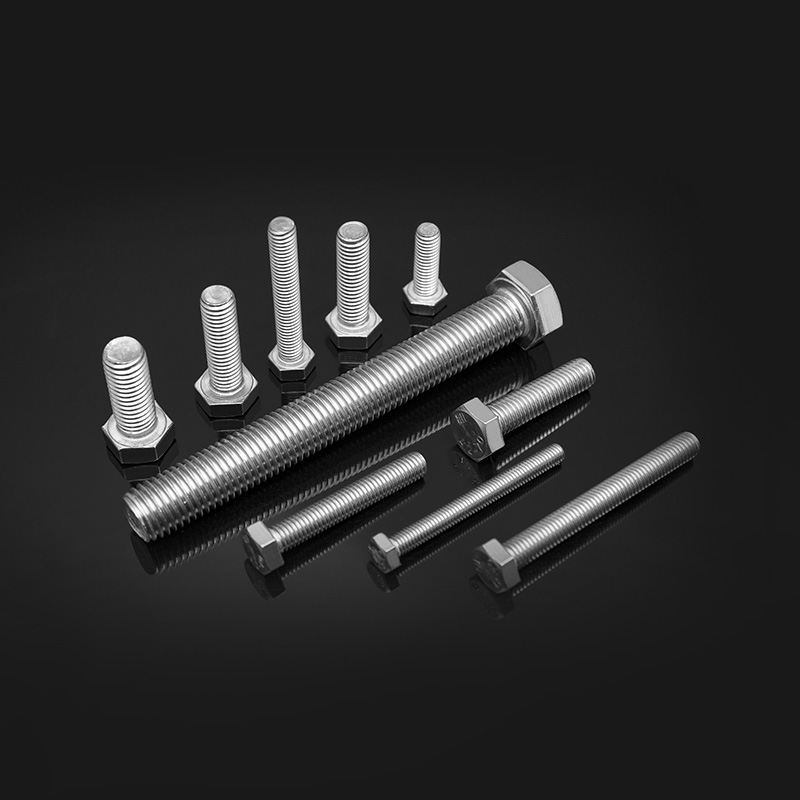
ThreadTolerance: 6gstandardDIN 13-15、DIN 13-12Rod diameter dd≤M20:A2-70、A4-70;M20<d≤M39:A2-50、A4-50;d≥M39:C3、C4;d<M39
See Details
Copyright © Jiangsu Huajie Stainless Steel Products Co., Ltd. All Rights Reserved.