eng
 English
 русский
 Deutsch
 عربى
+86 189 6101 2359
+86 133 6521 5663
+86 138 5268 6835
A screw looks simple until you watch one being made. On our floor in Jiangsu, a coil of stainless wire disappears into one end of a heading machine and comes out the other side as thousands of finished fasteners, each one formed rather than carved. Most people picture a machinist cutting a spiral into a rod, but that is not how the screw in your hand was born. It started as wire, and it was squeezed into shape under pressure, with almost no material wasted.
What follows is close to the walkthrough we give visitors who come to see the line: what happens at each station, why the process is arranged that way, and where the difference between an ordinary screw and a dependable one is actually decided.
Content
Ask most people how a screw is made and they describe a lathe: a rod spinning while a tool carves a spiral into it. That method exists and we still use it for special work, but it accounts for a very small share of the screws in circulation. The great majority are produced by cold heading, a forging process that pushes metal into the shape of the screw instead of removing metal from it.
There are three broad routes to a finished screw, and the choice usually comes down to volume, size, and how unusual the geometry is.
| Method | How the shape is produced | Where it fits best |
|---|---|---|
| Cold heading | Cut wire is forced into a die cavity by one or more punches, so the metal flows into shape | High-volume screws, roughly M2 to M24 |
| Machining from bar | Material is cut away on lathes or CNC centres until the profile appears | Prototypes, small batches, unusual geometries |
| Hot forging | Billets are heated before forming so the metal moves more easily | Large fasteners and heavy-duty studs |
For a normal production run of, say, a few hundred thousand M6 socket head cap screws, cold heading wins on speed, strength, and material cost. The deformation also improves the metal, because the grain structure bends to follow the outline of the head and shank instead of being sliced through.
Once a screw is scheduled for cold heading, it passes through the same sequence of stations, with variations for the head style, the drive, and the thread.
Stainless wire arrives on coils that can weigh anywhere from a few hundred kilograms to more than a tonne. It is pulled off the coil, straightened through a set of rollers, and fed into the header until it hits a stop. A shear then cuts it to the exact volume of metal the finished screw will need, no more. That short cylinder is called a blank or a slug, and its diameter is chosen so that the head can be formed without running out of material.
The blank drops into a stationary die. One punch, or a series of up to five, strikes it in quick succession, each with a slightly different cavity. The first blow roughs out the head, later blows finish it, reduce the shank if a shoulder is needed, and punch the drive recess. All of this happens cold, at room temperature, in a fraction of a second. This is also where the drive is born: a hexagon socket, a cross recess, a slot, or a star shape, each with its own punch geometry and its own tolerances.
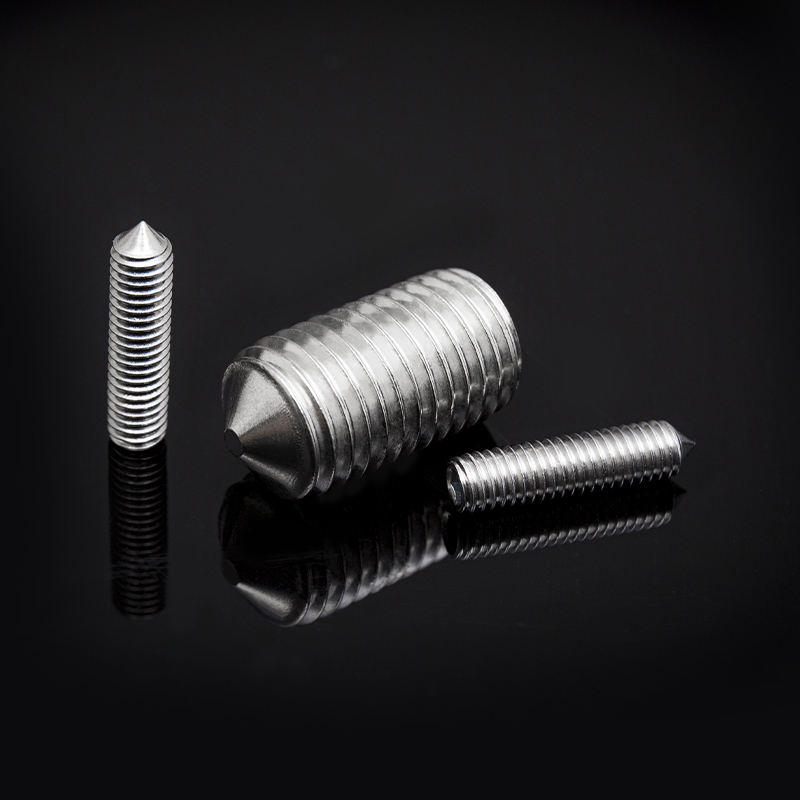
If the head carries a flash or needs a clean bearing face, a trim die shaves it away. The tip is then pointed, whether that means a simple chamfer, a cone, a flat point, or a drill point for self-drilling screws. A well-formed point lets the screw start straight and lets the first thread engage cleanly instead of skidding across the surface.
Almost nobody cuts threads on a production screw. Two flat or cylindrical dies, one fixed and one reciprocating, press the blank between them while rolling it, and the metal is displaced outward into the thread profile. Because the thread is formed rather than cut, the grain runs continuously along the flanks, there is no chip and no waste, and the finished thread is stronger and more fatigue resistant than a cut one. Gauges check the result afterwards: a go gauge must pass, a no-go gauge must not.
Not every screw is heat treated. Austenitic stainless grades such as 304 and 316L cannot be hardened by heat treatment, so they stay in the cold-worked condition produced by heading and rolling, or they are annealed to soften them for further forming. Carbon and alloy steel screws follow a different path, going through quenching and tempering until they reach the property class printed on the box. The interplay between thermal treatment and cold deformation is a topic we return to often, and it is covered in more detail in our note on how heat treatment and cold working influence fastener strength.
Cleaning comes next. Stainless parts are degreased and passivated so that free iron is dissolved from the surface and the chromium oxide layer can rebuild itself. Then come the finishing choices: plain, zinc plated, black oxide, PTFE coated, or waxed for assembly lines that need consistent torque. After drying, the parts are ready for the sorting table.
The head is a small piece of design work that decides how a screw behaves in service. A hexagon head spreads load across a large bearing face and can be turned with an ordinary wrench. A pan head is gentler on the workpiece. A countersunk head sinks flush. A flange head carries its own washer. Each shape answers a question about clearance, load, and how the tool reaches the fastener.
Socket head cap screws are a good example of a shape earning its place. The internal hexagon lets a user apply high torque in a recessed pocket where no wrench would fit, and the cylindrical head centres itself in a counterbore, which makes them a favourite on machine tools and dies.
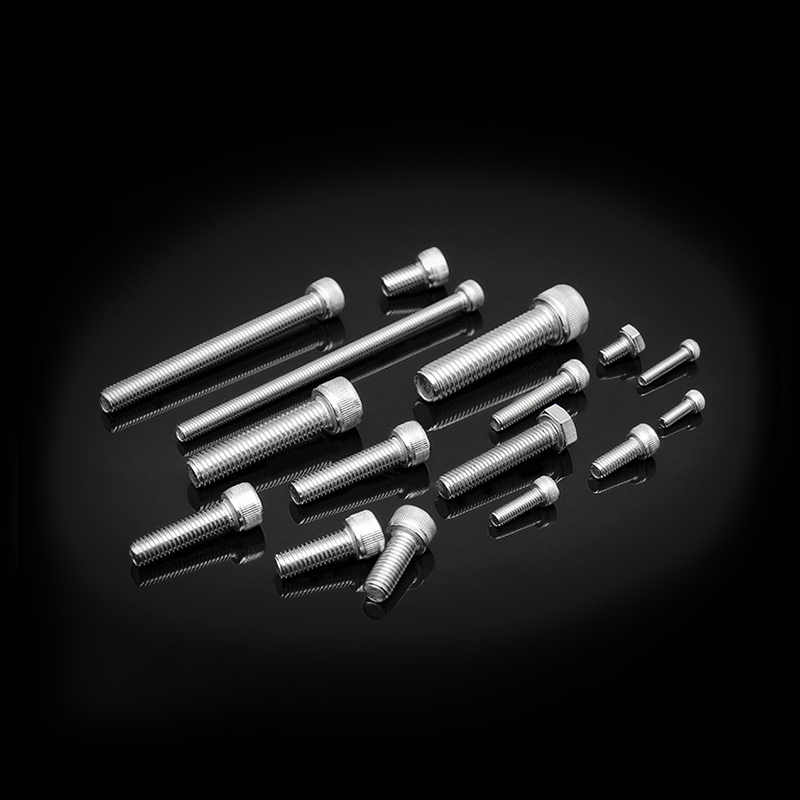 DIN 912 Stainless Steel Hexagon Socket Head Cap ScrewsView this DIN 912 range for internal-hex screws with full thread and metric sizes from M1.4 to M100, suited to torque-critical machinery and automotive connections.View Product →
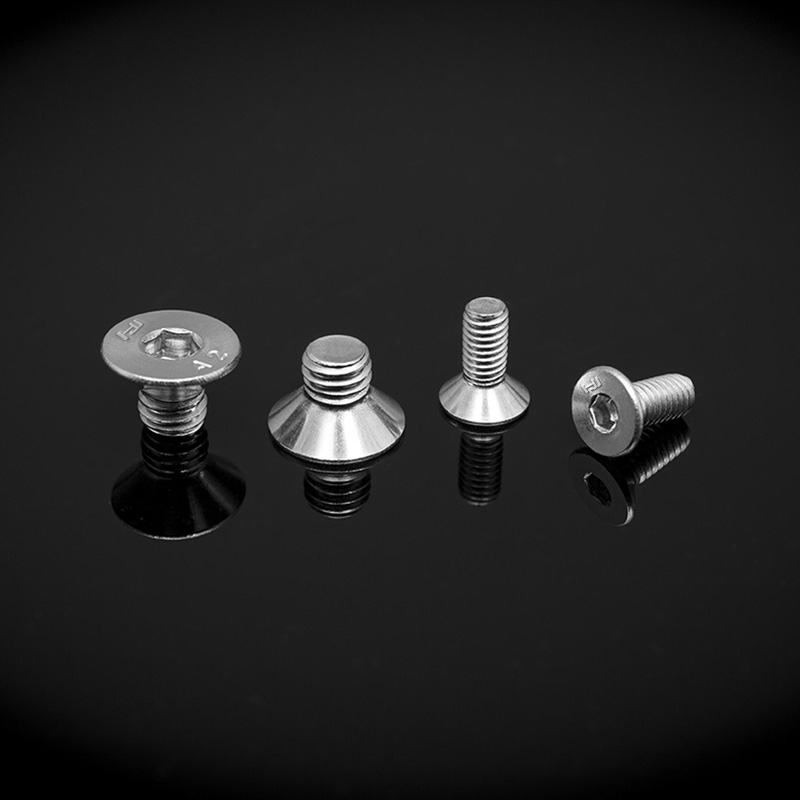
Where the head has to disappear below the surface, a countersunk screw with a cross recess is the usual answer. The 90-degree underside pulls the screw into the hole and centres it, while the cross recess lets the driver stay engaged even at a slight angle.
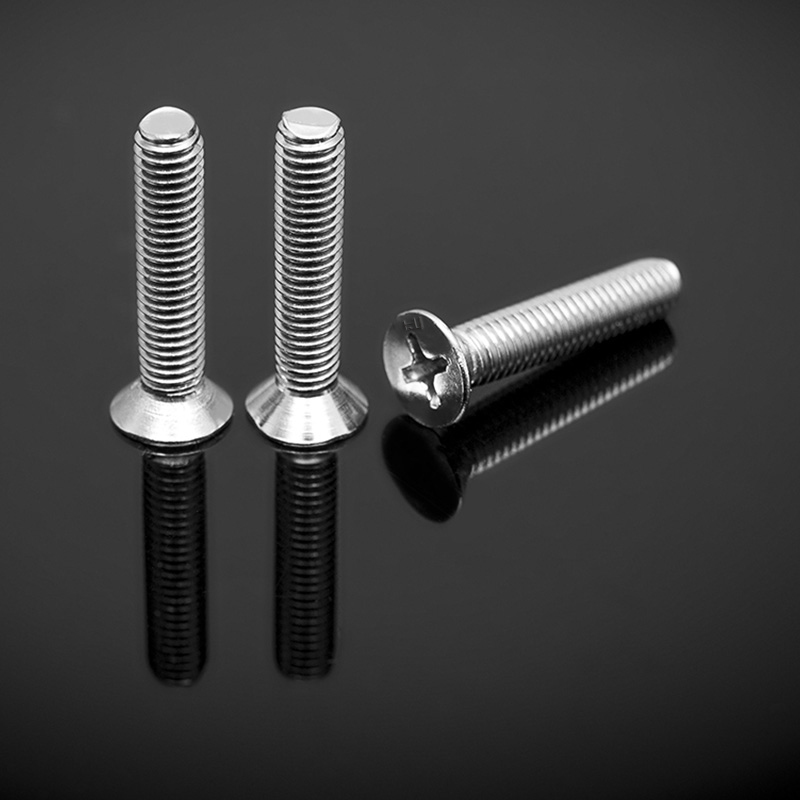 DIN 965 Stainless Steel Cross-Recessed Countersunk ScrewsFor flush installations, this DIN 965 range offers 90° countersunk heads and cross recesses in M1.6–M10 sizes for furniture, woodworking, and light equipment.View Product →
Most of what leaves our plant is stainless, and the process shifts in a few important ways. Austenitic grades work harden quickly, so each heading blow and each thread roll has to be planned around a metal that gets stronger as it deforms. Push it too far and cracks appear at the head fillet; push it too little and the thread flanks stay soft. Tooling, lubrication, and press speed all have to be tuned to the grade.
Galling is the other constant companion. Stainless threads have a tendency to cold-weld to themselves during assembly, which is why thread rolling lubricants matter and why some customers ask for a dry-film coating. Grade selection carries the rest: 304 handles most indoor and food-contact work, while 316L earns its higher price in chloride-heavy settings such as coastal platforms or chemical lines. If you want a broader view of where stainless pays off, our article on the advantages of stainless steel screws goes through the practical side.
A finished screw carries its identity in letters and numbers: a standard, a size, a length, and a property class. The standard tells you the head dimensions, the thread tolerances, and the mechanical requirements, which is why buyers who know the code can compare offers from three continents without opening a drawing.
| Standard | Product | What it defines |
|---|---|---|
| DIN 912 | Hexagon socket head cap screw | Head diameter, socket size, shank and thread tolerances |
| DIN 933 | Hexagon head screw, threaded to the head | Full thread length, head across flats, bearing face |
| DIN 965 | Cross recessed countersunk head screw | Head angle, recess dimensions, countersink depth |
| DIN 125 | Plain washer | Inner and outer diameter, thickness, flatness |
| DIN 985 | Prevailing torque hexagon nut | Insert height, torque performance, proof load |
One of the most widely used profiles in general assembly is the fully threaded hexagon head screw, because it can be tightened from any angle and works with the simplest tooling on site.
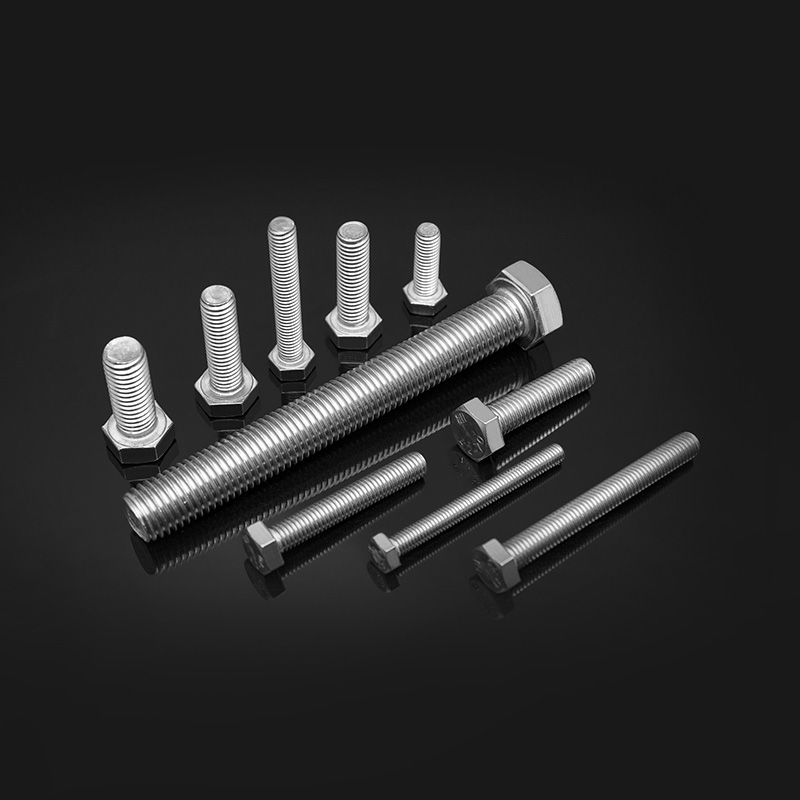 DIN 933 Stainless Steel Fully Threaded Hexagon Head BoltsThis DIN 933 range covers full-thread hexagon bolts from M1.6 to M52 for heavy-duty equipment, machinery, automotive, and construction connections requiring high load capacity.View Product →
Inspection is not one gate at the end; it is a series of small checks placed where a problem would otherwise become expensive. The main ones look like this.
Records from each step stay with the lot, so if a customer asks six months later which coil a carton came from, the answer is on file.
So, how is a screw made? Wire is straightened and cut, headed into shape in a fraction of a second, pointed, thread rolled between hardened dies, then cleaned, treated, finished, and measured until it matches a standard. It is a short process with a lot of small decisions inside it, and those decisions are what separate a fastener that quietly does its job for twenty years from one that strips on the assembly line.
We have been making stainless fasteners since 2003, in a plant that runs to about 60,000 tonnes a year across bolts, screws, nuts, studs, and washers in 201, 304, and 316L, to GB, JIS, DIN, ANSI, and ISO standards. If you are working through a specification and want a second opinion on the head, the thread, or the grade, our engineers are glad to talk it through before anything is cut.
ThreadTolerance: 6gstandardDIN 13-15、DIN 13-12Rod diameter dd≤M20:A2-70、A4-70;M20<d≤M39:A2-50、A4-50;d≥M39:C3、C4;d<M39
See Details
Copyright © Jiangsu Huajie Stainless Steel Products Co., Ltd. All Rights Reserved.