eng
 English
 русский
 Deutsch
 عربى
+86 189 6101 2359
+86 133 6521 5663
+86 138 5268 6835
Choosing bolts by grade can feel more complicated than it should. One supplier quotes 304, another talks about A2-70, and a drawing may call for ASTM B8. They are all describing stainless steel bolts, but they are not describing the same thing. Once you separate the material from the property class, the picture becomes much clearer.
In our experience on the shop floor, most specification problems come from mixing those two ideas. This guide walks through the grades of stainless steel bolts you are most likely to compare, what their labels mean, and how to match them to real service conditions without overpaying for corrosion resistance you do not need.
Content
A material grade tells you what the stainless steel is made of. Common bolt grades include 201, 304, 316, 316L, and 410. The familiar “18-8” label is not a single formal grade either; it broadly describes a 300-series stainless steel with roughly 18% chromium and 8% nickel. In practice, 18-8 usually means a 304-type material.
A bolt property class tells you what the finished fastener can do. Metric stainless bolts often carry marks such as A2-50, A2-70, or A4-80. Here, A2 refers to a 304-type austenitic stainless steel and A4 refers to a 316-type grade, while 50, 70, and 80 indicate minimum tensile strength levels in a simplified form. The class depends on chemistry, cold working, and manufacturing route, not just the grade name stamped on the box.
North American specifications work differently again. ASTM A193 B8, for example, points to a 304-type bolting material, while B8M points to a 316-type material. The specification brings its own requirements for chemistry, strength, and testing. That is why “304” alone is rarely enough for a critical joint.
Most projects compare a small group of grades. The right choice depends on corrosion exposure, mechanical load, temperature, and the standard governing the connection.
| Grade family | Common names | Corrosion resistance | Typical bolt use |
|---|---|---|---|
| 201 | 201 stainless | Moderate | Dry indoor applications and cost-sensitive assemblies |
| 304 | 18-8, A2 | Good in most general environments | Machinery, furniture, food equipment, general construction |
| 316 | A4 | Very good, especially against chlorides | Marine, chemical, coastal, and wash-down areas |
| 316L | Low-carbon 316 | Very good, with better weld-zone behavior | Welded assemblies and corrosion-sensitive equipment |
| 410 | Martensitic stainless | Moderate to limited | Hardware needing hardness and wear resistance, not severe corrosion |
304 is the workhorse grade for stainless steel bolts. It offers a sensible balance of strength, corrosion resistance, and availability. For indoor machinery, clean production areas, and many general assemblies, it is often the first grade to consider. It is not the best choice for salt spray, strong chlorides, or continuous wet exposure.
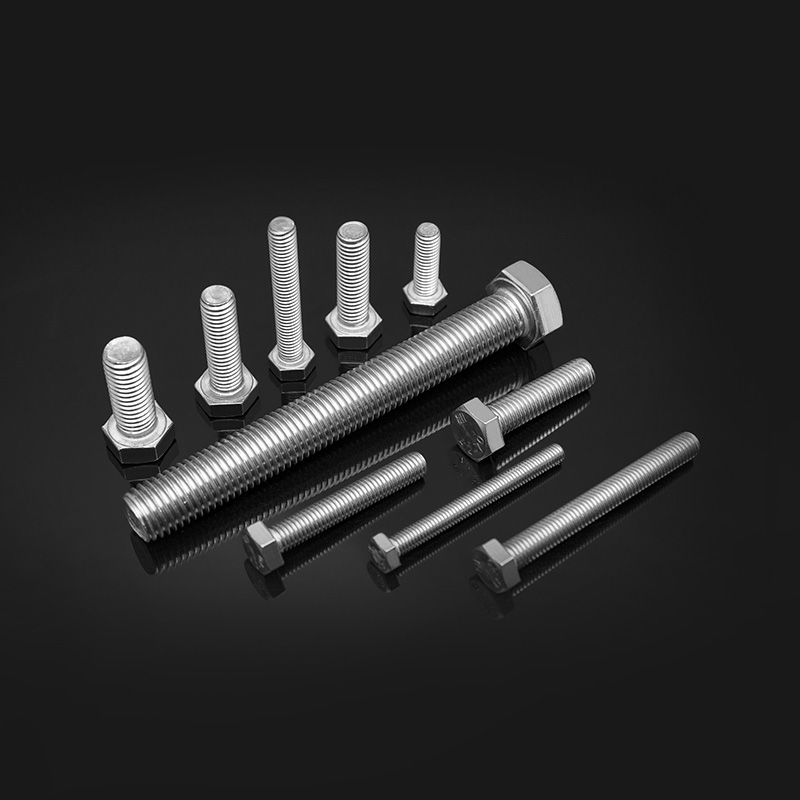 Stainless Steel Hexagon Head Bolts for Multiple StandardsCompare 201, 304, and 316L hexagon head bolts across DIN, ANSI, ISO, GB, and JIS standards for machinery and structural connections.View Product →
316 adds molybdenum, which improves resistance to chlorides and many aggressive chemical environments. It is the grade most buyers reach for in coastal sites, marine equipment, and wash-down plants. 316L has a lower carbon content, which helps reduce carbide precipitation in welded zones. The “L” does not automatically make a bolt stronger; the property class still matters.
201 is an economical austenitic grade used where corrosion demands are modest. It can be a practical choice for dry indoor work, but it should not be substituted for 304 in a corrosive environment without careful review. 410 is a martensitic grade that can be hardened. It is useful when wear resistance or hardness matters more than long-term corrosion performance, but it is not a marine bolt grade.
When a drawing specifies A2-70, it is asking for more than a 304-type material. The “70” points to a minimum tensile strength level of roughly 700 MPa for the finished bolt, usually achieved through cold working. A4-80 does the same for a 316-type material at a higher strength level. A2-50 generally indicates a softer, annealed condition with lower strength.
This distinction matters because two bolts can share the same corrosion-resistant chemistry but perform very differently in a loaded joint. A cold-worked A2-70 bolt and an annealed A2-50 bolt may both be “304,” but they are not interchangeable in a pressure-containing or vibration-prone assembly.
Start with the environment rather than the grade name. A dry indoor machine frame may be perfectly well served by 304 hex bolts. A coastal walkway, a food wash-down line, or a chemical skid is a different conversation. In those cases, 316 or 316L is usually easier to justify, especially where chlorides are present.
For general machinery, 304 is often the practical default. For marine and coastal areas, move to 316. For welded fabrications that will see moisture or chemicals, 316L can reduce sensitization risk in the weld zone. For high-hardness wear parts, 410 may be more suitable, but confirm that the lower corrosion resistance is acceptable.
Do not forget the fastener standard. A fully threaded hex bolt may suit one joint, while a partially threaded bolt may be required for another. At our plant, we produce stainless steel hexagon head bolts in DIN 933 and DIN 931 forms, among other standards, so buyers can match the grade and the geometry to the drawing instead of compromising one for the other.
DIN933 Stainless Steel Hexagon Head Bolts, Fully ThreadedFully threaded DIN933 bolts in metric sizes M1.6 to M52 support heavy-duty connections; match thread tolerance, material grade, and property class to the drawing.View Product →Stainless bolts are not automatically stronger than carbon steel bolts. Austenitic grades such as 304 and 316 work-harden well, but their strength depends on the property class and diameter. A 316 bolt is not necessarily stronger than a 304 bolt just because it costs more. Its advantage is corrosion resistance.
316L is often chosen for welded assemblies because the lower carbon level reduces the risk of chromium carbide precipitation near welds. However, low-carbon chemistry can slightly reduce strength compared with a higher-carbon grade at the same cold-work level. For elevated-temperature service, do not assume that any stainless grade is suitable; check the governing specification and the expected temperature range.
Galling is another practical issue with austenitic stainless bolts. Threads can seize during assembly, especially with stainless nuts. A suitable anti-seize lubricant or a controlled tightening procedure can make a real difference, particularly on larger sizes.
ISO 3506 is a common reference for stainless steel fasteners and uses the A2 and A4 designations. DIN standards such as DIN 933 and DIN 931 describe bolt geometry and dimensions. ASTM specifications such as A193 and A320 use B8 and B8M designations for 304-type and 316-type bolting. GB and JIS standards may appear on Chinese and Japanese project documents.
A useful certificate should connect the material grade, the property class, and the dimensional standard. If a supplier can only confirm “stainless steel” without identifying the grade and class, the specification is incomplete. This is one reason we keep our production and testing aligned with ISO, DIN, ANSI, GB, and JIS requirements across our stainless steel bolt range.
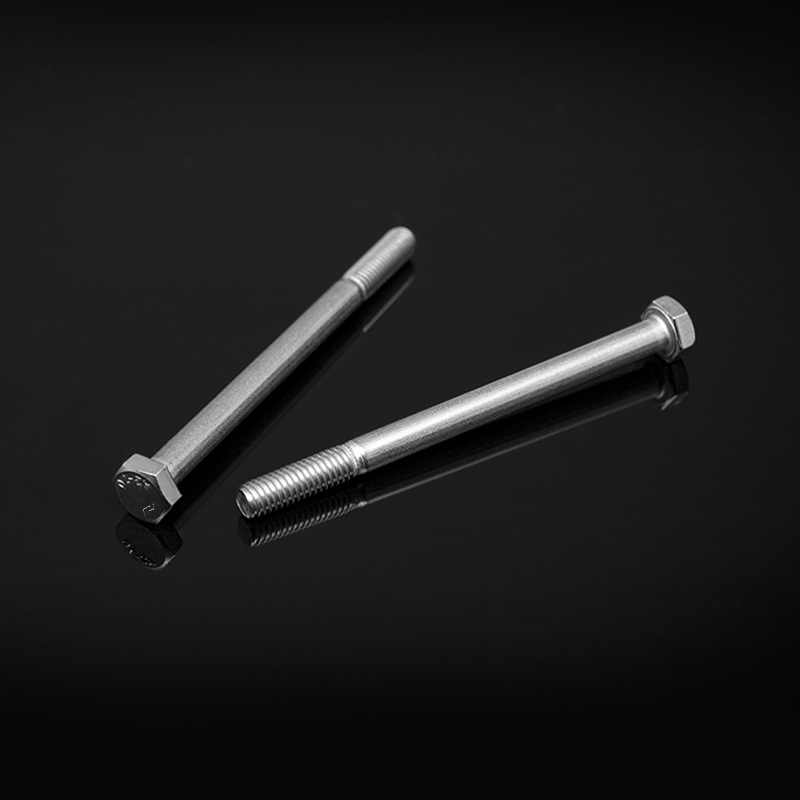 DIN931 Stainless Steel Hexagon Head Bolts, Partially ThreadedPartially threaded DIN931 hex bolts suit rough-surface and quick-tightening connections; available from M68 to M160, with 304 stainless steel among material options.View Product →
Before you settle on a grade, run through these questions with the project engineer or purchaser. They usually expose the real requirement faster than a catalogue comparison.
If you want a more detailed walk-through, our team keeps a practical guide to choosing stainless steel bolts that covers these decisions in project language.
Grade selection is only useful if the delivered bolts consistently match the certificate. Our company has been manufacturing stainless steel fasteners since 2003, with a plant of about 80,000 square meters and an annual capacity of around 60,000 tonnes. We work with 201, 304, and 316L materials and hold ISO 9001, ISO 14001, and ISO 18001 certification. That background helps when a buyer needs the same grade, class, and dimensional standard repeated across shipments rather than only on the first sample.
The grades of stainless steel bolts are easier to manage when you treat material grade, property class, and product standard as three separate decisions. Choose 304 for general service, 316 or 316L for aggressive corrosion exposure, and 410 only when hardness and wear justify the corrosion trade-off. Then confirm the class and geometry on the drawing. That simple sequence prevents most of the costly substitutions we see in fastener inquiries.
ThreadTolerance: 6gstandardDIN 13-15、DIN 13-12Rod diameter dd≤M20:A2-70、A4-70;M20<d≤M39:A2-50、A4-50;d≥M39:C3、C4;d<M39
See Details
Copyright © Jiangsu Huajie Stainless Steel Products Co., Ltd. All Rights Reserved.