eng
eng English
 русский
 Deutsch
 عربى
عربى
+86 189 6101 2359
+86 133 6521 5663
+86 138 5268 6835
Content
A spring washer is a type of load-indicating, resilient fastener component designed to sit beneath a nut or bolt head and perform mechanical work beyond the simple load distribution provided by a flat washer. Unlike flat washers, which are entirely passive, spring washers store elastic energy when compressed during tightening and release that energy progressively as the joint experiences thermal movement, vibration, or relaxation. The result is a fastened joint that maintains a more consistent clamping force over time than one assembled with flat washers alone.
When this geometry is manufactured from stainless steel — most commonly austenitic grades A2 (304) or A4 (316) — the washer gains a further set of properties that make it suitable for demanding service environments. Stainless steel grades combine meaningful spring characteristics with resistance to oxidation, aqueous corrosion, and a wide range of chemical exposures, without the surface coatings that carbon steel spring washers depend on for their corrosion resistance. This combination of mechanical function and materials performance explains why stainless steel spring washers appear across industries as diverse as marine engineering, food processing, pharmaceutical manufacturing, electronics, and civil infrastructure.
The primary mechanical function of a spring washer is to resist self-loosening of threaded fasteners in assemblies subject to vibration or dynamic loading. When a bolted joint is exposed to cyclic transverse or axial forces, the nut and bolt tend to undergo small rotational movements that gradually reduce clamp load — a phenomenon studied extensively since G.H. Junker's foundational research in the 1960s. A spring washer addresses this by maintaining an axial spring force against the nut face even as the joint undergoes small amounts of settling or relaxation. The split ring geometry of a helical spring washer also presents edges that bear into the mating surfaces, creating a mechanical resistance to rotation that supplements the friction-based locking mechanism of the thread itself.
In practice, stainless steel spring washers are specified in vibration-prone assemblies including pump and compressor mountings, marine deck hardware, rail and transport fixings, and structural brackets on equipment subject to continuous operational vibration. The stainless steel material ensures that the spring function is not compromised by corrosion of the washer body — corroded carbon steel spring washers lose their spring characteristics as section loss reduces the effective spring rate, leading to a false sense of security in the joint.
All bolted joints experience some degree of clamp load loss after initial tightening, caused by embedding of surface asperities, thread settlement, and gasket relaxation. In joints that undergo thermal cycling — for example, pipework flanges, engine components, or structural connections exposed to outdoor temperature swings — differential thermal expansion between dissimilar materials adds a further source of clamp load variation. A stainless steel spring washer acts as a compliant element in the joint stack, absorbing these dimensional changes through elastic deformation and maintaining a residual clamping force that a rigid flat washer cannot provide.
The austenitic stainless steel grades most commonly used for spring washers have a coefficient of thermal expansion of approximately 17–18 × 10⁻⁶ /°C, which is higher than carbon steel (approximately 12 × 10⁻⁶ /°C) but compatible with the stainless steel fasteners and fittings typically used in the same assemblies. When spring washers and fasteners are matched in material grade, thermal expansion compatibility minimizes differential movement within the joint and preserves the designed spring function across the operating temperature range.
Like flat washers, spring washers distribute the bearing load of the nut or bolt head over a larger area of the mating surface, reducing compressive stress on softer substrate materials such as aluminium, plastics, composites, and timber. The stainless steel material is particularly valuable in this role when the substrate is itself stainless steel or another corrosion-resistant alloy, because matched-material washers eliminate the risk of galvanic corrosion that would occur if a carbon steel washer were interposed between stainless fasteners and a stainless or aluminium structure.
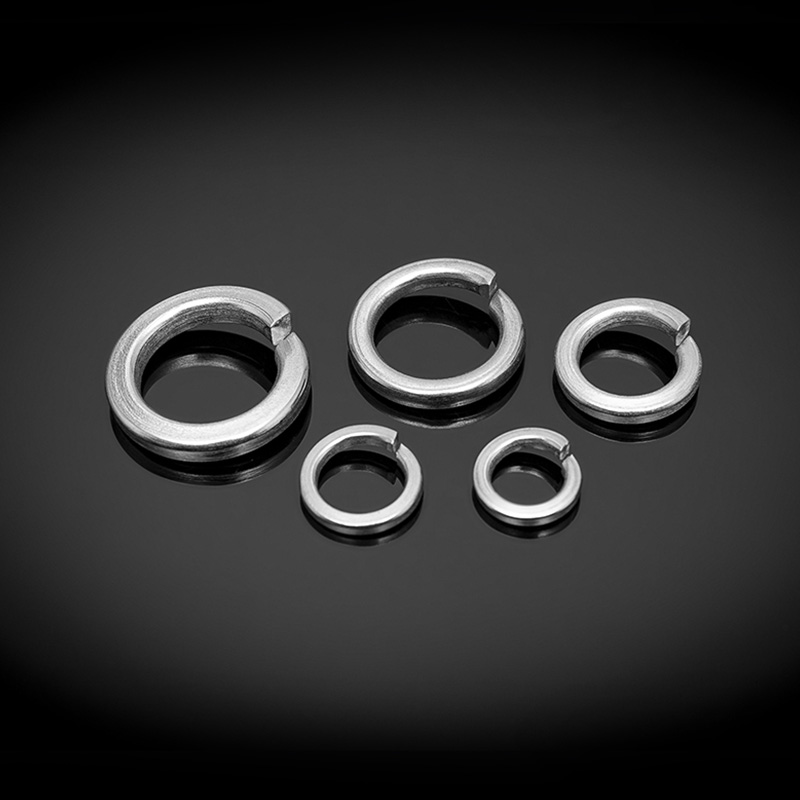
The most significant advantage of stainless steel spring washers over their carbon steel equivalents is corrosion resistance. Carbon steel spring washers rely on a surface coating — most commonly zinc electroplate, yellow passivate, or black oxide — to provide corrosion protection. These coatings are thin (typically 5–12 μm for zinc plate) and are easily damaged during installation as the washer's sharp edges are compressed against the nut and substrate. Once the coating is breached, the underlying carbon steel corrodes rapidly, and in many environments the washer seizes to the fastener or substrate, complicating future disassembly.
Stainless steel grades A2 and A4 derive their corrosion resistance from a passive chromium oxide film that forms spontaneously on the surface and self-repairs when damaged in the presence of oxygen. This passive film provides durable protection without any applied coating, meaning that installation damage, scratching, or edge exposure does not create preferential corrosion sites. A4 (316) grade stainless steel, which contains 2–3% molybdenum, extends this protection to chloride-rich environments — seawater, coastal atmospheres, de-icing salt exposure, and chemical process streams — where A2 grade would experience localised pitting corrosion over time.
In food processing, pharmaceutical, and chemical industry installations, fastener components must resist not only process chemicals but also the aggressive cleaning agents — hypochlorite solutions, phosphoric acid cleaners, caustic alkalis — used in sanitisation cycles. A4 stainless steel spring washers maintain their passive film and mechanical properties through repeated exposure to these cleaning agents, whereas zinc-plated or cadmium-plated carbon steel washers dissolve rapidly and contaminate the process environment. This makes stainless spring washers a regulatory requirement in many hygienic design standards, including those published by EHEDG and 3-A Sanitary Standards.
The spring function of a washer depends on the elastic modulus, yield strength, and work-hardening behaviour of the material. Austenitic stainless steels in the annealed condition have a lower yield strength than hardened carbon spring steel, which would suggest inferior spring performance. However, spring washers made from stainless steel are cold-formed from work-hardened strip or wire, which significantly increases the effective yield strength — cold-worked A2 stainless can achieve tensile strengths of 700–1,000 MPa depending on the degree of cold work, providing adequate spring characteristics for the majority of fastening applications.
The elastic modulus of austenitic stainless steel (approximately 193–200 GPa) is essentially the same as carbon steel, meaning that for a given washer geometry and deflection, the spring force generated by a stainless steel washer is comparable to that of an equivalent carbon steel washer. This allows stainless steel spring washers to be substituted for carbon steel equivalents in most applications without redesigning the joint or recalculating tightening torques, provided the washer dimensions conform to the same standard (DIN 127, ISO 7980, or equivalent).
| Property | Stainless Steel (A2/A4) | Carbon Steel (Zinc Plated) |
|---|---|---|
| Corrosion resistance | Excellent (inherent, self-repairing) | Moderate (coating-dependent) |
| Spring function after installation | Maintained long-term | Degrades with corrosion |
| Chloride resistance | Good (A4) / Moderate (A2) | Poor |
| Galvanic compatibility with SS fasteners | Fully compatible | Risk of galvanic corrosion |
| Hygienic / food-safe suitability | Yes | No |
| Unit cost | Higher | Lower |
| Service life in outdoor/wet environments | Very long | Short to moderate |
To realise the full functional benefit of a stainless steel spring washer, correct selection and installation practice are both essential. Several practical points warrant attention during specification and assembly.
Stainless steel spring washers represent a modest cost premium over carbon steel alternatives, but in applications where joint reliability, long service life, and freedom from maintenance-related failures are valued, that premium is consistently justified. The combination of durable spring function, inherent corrosion resistance, and compatibility with corrosion-resistant fastener systems makes stainless steel spring washers the technically correct choice for any application where the consequences of joint loosening or corrosion-related failure are significant.
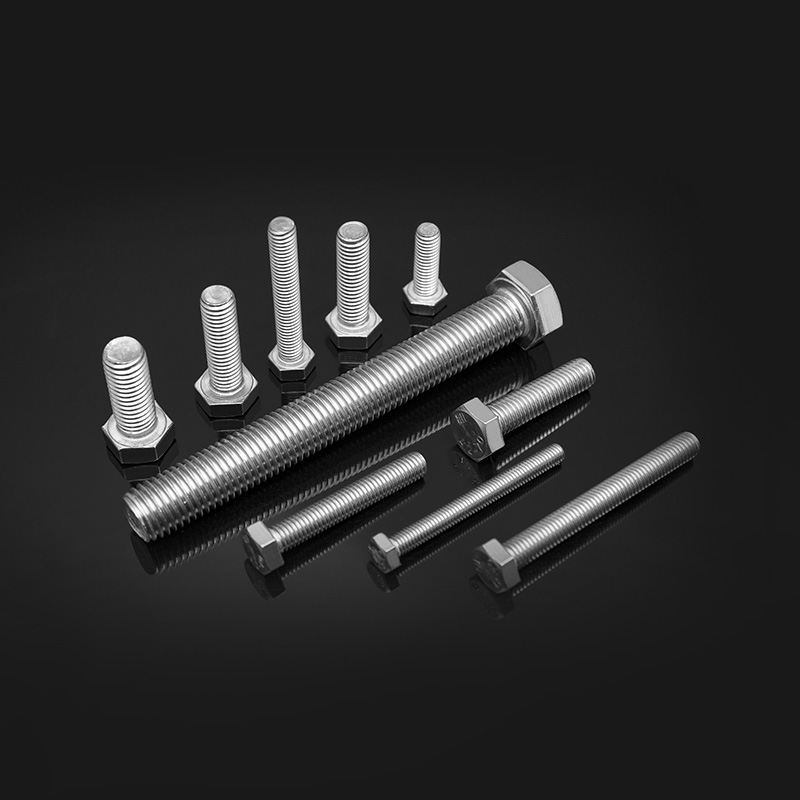
ThreadTolerance: 6gstandardDIN 13-15、DIN 13-12Rod diameter dd≤M20:A2-70、A4-70;M20<d≤M39:A2-50、A4-50;d≥M39:C3、C4;d<M39
See Details
Copyright © Jiangsu Huajie Stainless Steel Products Co., Ltd. All Rights Reserved.